

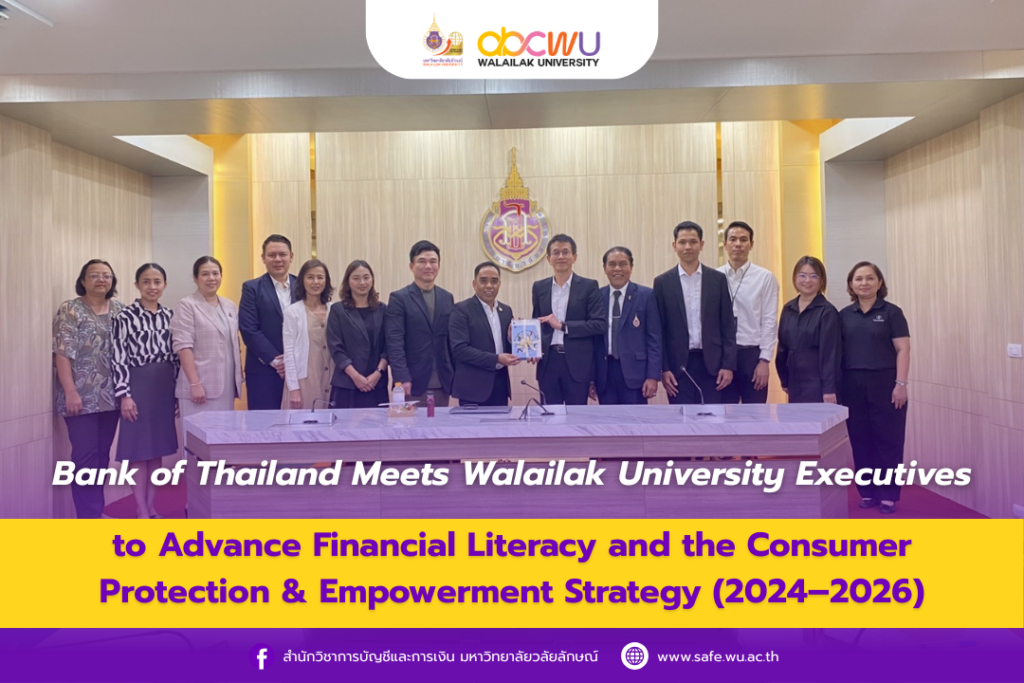
On Thursday, 12 February 2026, from 11:00–12:00, representatives from the Bank of Thailand (BOT) paid a courtesy visit to Walailak University executives to discuss potential collaboration in driving forward the Consumer Protection & Empowerment Strategy 2024–2026. The strategy aims to promote lifelong financial well-being for Thai people and to enhance standards for fair and responsible financial services.
Under this strategic framework, the BOT has been advocating for Financial Literacy to be integrated as a compulsory subject at primary and secondary education levels, and as a General Education (GenEd) course in higher education. In addition, the BOT emphasizes strengthening teachers’ capacity—both newly qualified and in-service teachers—to effectively deliver financial education, as well as developing personnel with the skills to provide high-quality debt and financial problem-solving advice for community members.
The BOT recognizes Walailak University as a capable higher education institution that can support financial literacy advancement in multiple dimensions, including building students’ financial competencies, integrating financial knowledge into GenEd curricula, supporting teacher development, and cultivating community-based advisors who can contribute to sustainable household debt solutions and long-term financial well-being.
The School of Accountancy and Finance participated in the discussion, led by the Dean of the School of Accountancy and Finance, together with the Dean of the School of Languages and General Education and relevant university executives. The meeting explored both policy-level and practical cooperation, such as developing a Financial Literacy GenEd course, organizing teacher training programs, and designing curricula or activities that strengthen financial resilience among youth and the public in Southern Thailand.
This collaboration marks an important step for Walailak University in supporting national financial literacy priorities and reflects the School of Accountancy and Finance’s key role in developing financial human capital for a more sustainable Thai society.